
What Type of Massage Is Best for Office Workers?
Desk jobs are secretly really tough for our bodies. Spending so many hours bent over a keyboard and staring at a screen while hardly moving contributes to building up tension in the neck, shoulders, and lower back that is already present by afternoon but has managed to accumulate without anyone noticing. The good thing is that massage makes the tension go away but not all types of massage are appropriate for a work environment. Therefore, it is useful to get familiar with the existing options that lead to chair massage becoming the best choice for busy employees at work. You can see the whole range of our Boston chair massage services offered at corporate functions.
Quick Answer: What Type of Massage Is Best for Office Workers?
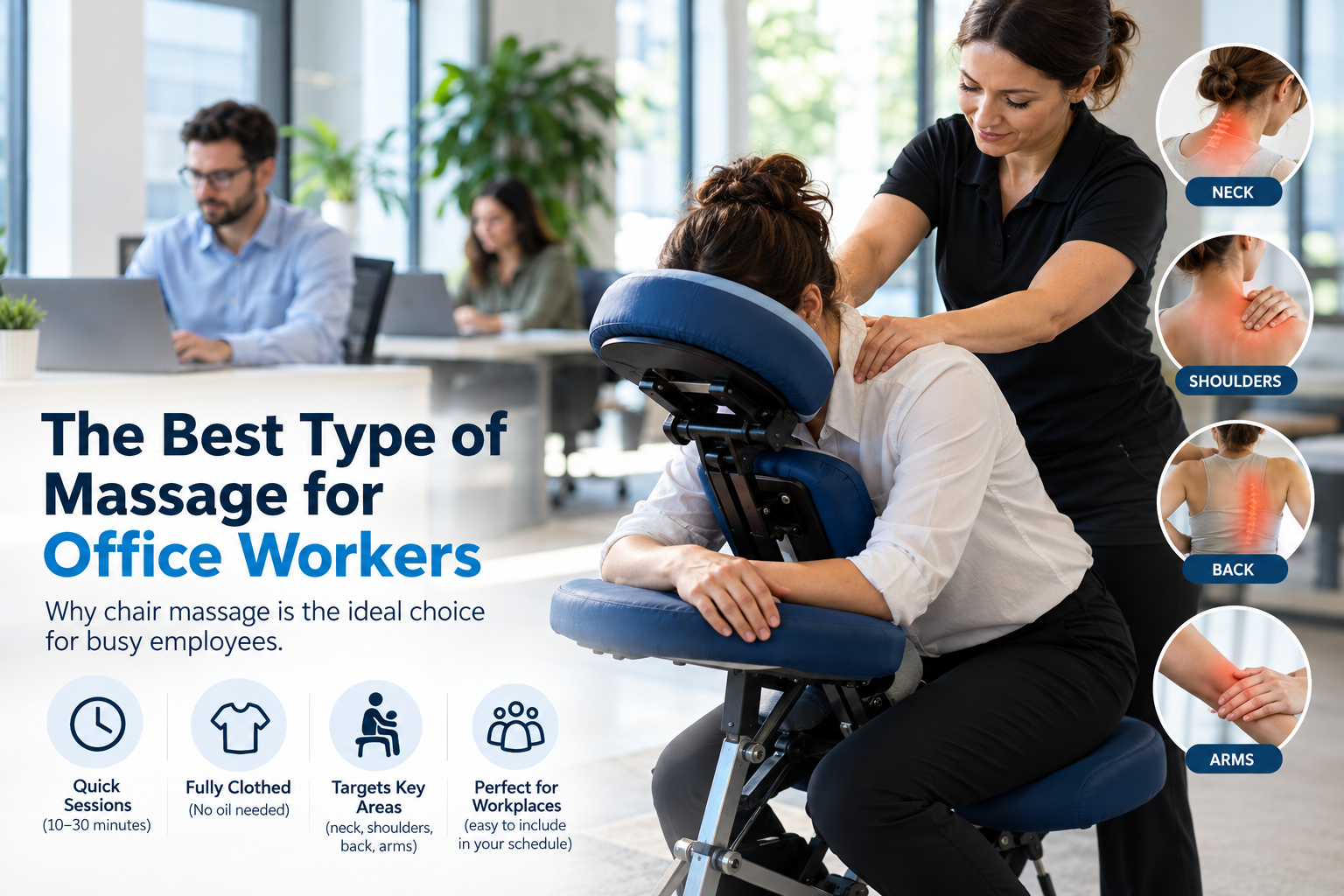
For the majority of office employees, chair massage is the perfect fit in that it focuses on the areas that are most stressed out by hours spent at the desk, that is, neck, shoulders, back, and arms. It’s a brief massage, taking only 10 to 20 minutes, while one would still be fully clothed and with no need of oils being used or dressing up. This is what makes chair massage so easy to include in a work schedule without disturbing meetings, deadlines, and concentration level – hence its widespread usage in today’s chair massage programs.
Why Desk Work Takes Such a Toll
The main reason why this is a problem is that the body is not able to stay in one position for 8 hours straight. Sitting with our shoulders rolled forward towards the laptop puts our neck under immense pressure and increases tension in certain muscles like the upper trapezius and lower back, to name a few. Unlike injuries, tense muscles tend to build up over time. Thus, with so many tension-related injuries, it is important to choose a type of massage that is done frequently rather than once in a while.
A Quick Look at the Main Massage Types
Deep Tissue Massage
Deep tissue massage uses a lot of pressure to get into sore spots in the muscles, and can also work on the muscle and fascia below the surface. It is great for chronic tension; however, sessions can last over 60 minutes, require clients to get undressed, use oil, and leave clients sore afterwards, making it unsuitable for busy schedules.
Swedish Massage
Swedish massage is described as being more relaxing in nature since it employs gentle strokes of massage which help in reducing tension, enhancing blood circulation and soothing the nervous system. This massage technique is ideal for achieving relaxation and reducing stress but like deep tissue massage, it also requires more time and is best suited to a spa session rather than a workday relaxation session.
Trigger Point Therapy
The procedure is based on the identification of certain “knots” or stiff parts in the muscle, which are sensitive points in the muscle system. These “knots” may result in some pain sensations in other areas of the body, e.g. tension in the shoulder may lead to pain in the arm. It helps to eliminate a particular problem, but it is usually included into longer sessions with professionals.
Shiatsu Massage
Based on the basis of traditional Japanese bodywork, Shiatsu uses palm and finger pressure along with body energy paths. It could be quite relaxing and is occasionally performed with a fully dressed patient, but sometimes sessions could take longer than average work breaks.
Chair Massage
Chair massage is performed while the client is fully dressed and seated in a specialized chair that is ergonomically designed so that the client leans in a cushioned way. Each session lasts between 10 and 30 minutes and specifically targets the back, neck, shoulders, and arms; these are the areas that usually accumulate tension from working behind the desk. But this massage does not use any oils, does not require clients to change their clothes, and does not require clients to take out hours from their day. To learn more about chair massage and how it works, follow the link provided.
Why Chair Massage Wins for Office Workers
The other kinds of massages aren’t bad. They are just designed for different settings. For office people, what they need is something suitable for a workday and not the other way around. Here are some reasons why chair massage is so good for this particular situation:
1. No disruption to the workday. A 10 to 20 minute session fits into a lunch break or between meetings, unlike a 60-minute deep tissue or Swedish session.
2. No undressing or oil. Employees can go straight from their desk to the chair and back again, fully clothed, with no need to freshen up afterward.
3. Targets the right areas. Desk work concentrates tension in the neck, shoulders, upper back, and arms exactly where chair massage focuses.
4. Easy to scale for groups. A single chair massage provider can work through a whole office in an afternoon, something that isn’t practical with longer, more involved massage types.
5. Consistent, repeatable relief. Because sessions are short, chair massage works well as a regular program (weekly or monthly) rather than an occasional treat and consistency is what actually helps with chronic desk-related tension over time. Many offices set this up as a recurring corporate chair massage program rather than a one-time event.
For a closer look at exactly how chair massage benefits people who sit at a desk all day, see our full guide on chair massage for office workers, or explore the broader benefits of on-site corporate chair massage.
How to Choose the Right Option for Your Office
If you’re deciding what fits your team best, a few quick questions help:
1. How much time do people realistically have? If it’s 10 to 20 minutes, chair massage is the practical choice. Longer, dedicated blocks open up options like Swedish or deep tissue.
2. Is this a one-time event or an ongoing program? Chair massage scales well for both, but especially shines as a recurring wellness benefit since it’s easy to repeat regularly.
3. What’s the space like? Chair massage needs only a small footprint — a corner of an office or a conference room works fine. Table-based massage types need more space and privacy.
In most offices, chair massage is invariably the answer to these questions. Using the concept of chair massage in bigger initiatives, such as organizing a wellness day or setting up a booth at a trade show, produces the same result; chair massage is an attention grabber, making people stay at the venue.
What to Look for in a Chair Massage Provider
Not every provider runs a program the same way, so it’s worth knowing what separates a well-run office chair massage session from a disappointing one:
1. Licensed, experienced therapists who are used to working efficiently in a corporate setting, not just a spa
2. Their own equipment – professional chairs and sanitizing supplies, so your office doesn’t need to provide anything beyond space
3. Clear scheduling for larger groups, so employees aren’t left waiting around or missing their turn
4. Flexibility on session length and frequency, whether you want a one-time event or a recurring weekly or monthly program
Asking about these upfront helps make sure the experience actually delivers the workday-friendly relief that makes chair massage the right choice in the first place. Not sure what fits your team? A few questions to ask before hiring a chair massage company can help you compare providers with confidence.
Bring Chair Massage to Your Office
If your team suffers from the daily pains caused by desk work – such as a stiff neck, tight shoulders and sore back – then a chair massage program for companies is one of the best methods to relieve stress without interrupting the working day. The sessions are short, do not need any special arrangements other than a small space, and can be adapted to companies of all sizes.
For more details about our chair massage services for offices, check our massage packages or contact us for a quote.
Frequently Asked Questions
What type of massage is best for office workers?
Chair massage is generally the best fit for office workers, since it’s quick (10 to 20 minutes), fully clothed, and targets the neck, shoulders, and back, the areas most affected by desk work without disrupting the workday.
How long does a chair massage session usually last?
Most chair massage sessions run between 10 and 30 minutes, depending on the setting and how many people need to be seen.
Is chair massage as effective as a full massage?
Chair massage focuses on a smaller set of areas than a full-body massage, but for the specific tension caused by desk work, neck, shoulders, upper back – it’s highly effective and far more practical to fit into a regular workday.
Can chair massage be a recurring office benefit?
Yes – many companies book chair massage on a weekly or monthly recurring basis, since consistency tends to provide more lasting relief than a single one-off session.
Do employees need to prepare anything for a chair massage session?
No preparation is needed. Chair massage is done fully clothed, so employees can simply step away from their desk, sit down, and return to work right after – no changing, oil, or downtime required.
How many employees can a chair massage session accommodate?
This depends on the number of therapists booked and the length of the event, but chair massage scales easily, a provider can typically work through dozens of employees in a single afternoon by bringing multiple therapists.